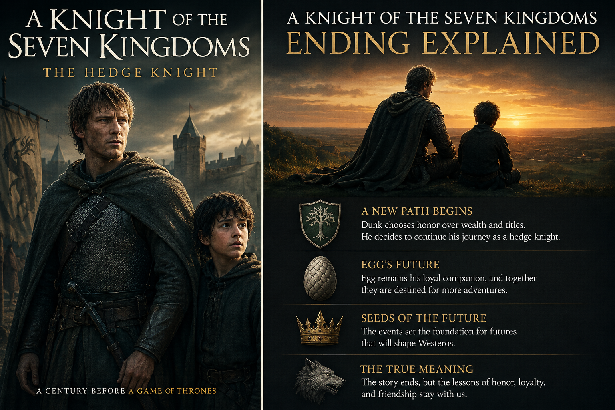
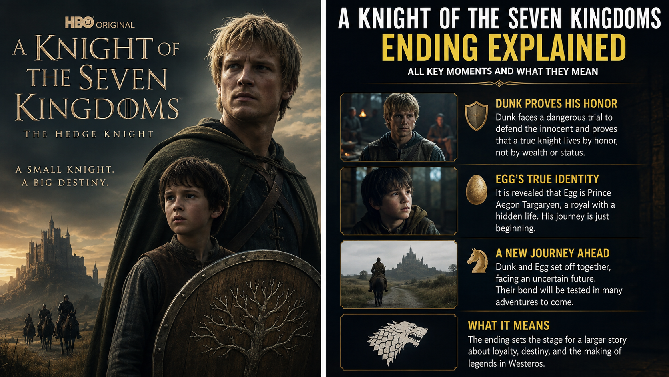
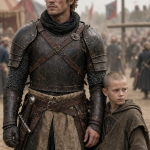
A Knight of the Seven Kingdoms ending explained begins with a simple answer: Dunk survives the Trial of Seven, but Prince Baelor Breakspear does not. His death changes Dunk emotionally and also changes the future of Egg.
After the trial, Dunk feels guilty. He believes that his actions helped cause Baelor’s death. However, Baelor’s death was not really Dunk’s fault. Baelor chose to fight for Dunk because he believed that Dunk was standing up for what was right.
Meanwhile, Prince Maekar offers Dunk a chance to stay at Summerhall and train Egg as his squire. At first, Dunk refuses. He says he wants no more trouble with princes.
However, Egg secretly chooses Dunk anyway.
The finale ends with Dunk and Egg riding away together. Egg tells Dunk that his father has given him permission to serve as his squire. Yet the final moments strongly suggest that Egg has lied.
Maekar later searches for Egg.
That means the real ending is not simply about a knight and his squire leaving Ashford.
Instead, it is about two young people choosing each other after a painful event.
The show also leaves one huge question unanswered: Was Dunk actually knighted by Ser Arlan of Pennytree?
The answer remains deliberately unclear. Showrunner Ira Parker has said he knows the truth, based on George R. R. Martin’s answer, but the series keeps the mystery alive.
HBO describes the series as a story set about a century before Game of Thrones, following Dunk and Egg as they form an unlikely friendship.
So, let’s break down the ending step by step.
Contents
A Knight of the Seven Kingdoms ending explained: where the finale starts
The final episode, “The Morrow,” starts after the terrible Trial of Seven.
Dunk is badly hurt.
He is alive, but his body is covered with injuries. More importantly, his heart is broken because Baelor Breakspear has died.
Baelor was one of the few powerful men in Westeros who treated Dunk with real respect.
That matters.
Dunk is a lowborn hedge knight. He has little money, little power, and almost no family name behind him.
Baelor, however, is a Targaryen prince.
He could have ignored Dunk.
Instead, he chose to stand beside him.
That choice tells us a lot about Baelor’s character.
The finale therefore does not begin with celebration. It begins with grief.
The tournament is over.
The excitement is gone.
The cheering crowds are gone.
What remains is the cost of the choices made during the tournament.
Baelor Breakspear’s death changes everything
One of the biggest points in A Knight of the Seven Kingdoms ending explained is Baelor’s death.
Baelor was not just another fighter.
He represented a better kind of Targaryen ruler.
He was strong, but he was not cruel.
He was powerful, but he did not treat common people as worthless.
Most importantly, he understood Dunk.
During the Trial of Seven, Baelor could have protected himself and his family.
Instead, he fought on Dunk’s side.
That decision helped prove that Baelor believed in justice more than family politics.
Unfortunately, Maekar’s blow to Baelor’s head caused a fatal injury.
Baelor later dies from that wound.
The tragedy becomes even stronger because Maekar did not simply defeat a rival.
He accidentally killed his own brother.
Therefore, both Dunk and Maekar leave the trial carrying guilt.
Why Dunk blames himself for Baelor’s death
Dunk spends much of the finale wondering whether Baelor would still be alive if Dunk had never challenged Aerion.
That is a natural reaction.
Dunk believes his actions started the chain of events.
However, the story wants us to question that idea.
Dunk did not create Aerion’s cruelty.
He did not force Aerion to attack Tanselle.
He did not force the prince to behave badly.
Dunk simply refused to accept that power should make someone immune from consequences.
That is one of the strongest ideas in the whole season.
A poor hedge knight stands up to a prince.
Then another prince chooses to stand beside him.
The result is tragic.
Still, Dunk’s decision was morally important.
That is why Baelor respected him.
The question Valarr asks Dunk
One of the saddest scenes involves Valarr Targaryen, Baelor’s son.
Valarr is grieving his father.
Dunk tries to comfort him.
He explains that Baelor was a great man.
Valarr agrees.
Then comes the painful question.
Why did the gods take Baelor and leave Dunk alive?
Dunk cannot answer.
He is asking himself the same thing.
This scene is important because Dunk does not suddenly become confident after the trial.
He does not say everything happened for a reason.
Instead, he admits that he does not understand it.
That makes him feel human.
The story does not give every tragedy a neat answer.
Sometimes good people die.
Sometimes bad people survive.
That is a major part of the world created by Martin.
A Knight of the Seven Kingdoms ending explained: Maekar’s guilt
Maekar also carries heavy guilt.
His attack killed Baelor.
Even though he did not mean to kill his brother, the result remains the same.
Maekar knows that people are already talking.
Some believe he may have wanted Baelor dead.
That is politically dangerous.
The Targaryen family already has complicated relationships.
Now there is a dead prince.
There are rumors.
There are questions.
And there is a young Egg caught between powerful brothers.
So Maekar has a difficult choice.
He can keep Egg close.
Or he can allow Egg to travel with Dunk.
At first, Maekar chooses the safer path.
He wants Egg at Summerhall.
Why Maekar wants Dunk at Summerhall
Maekar offers Dunk a position.
Dunk can serve him.
More importantly, Dunk can train Egg.
On paper, this sounds like a great opportunity.
Dunk would no longer need to struggle as a wandering hedge knight.
He could have food.
He could have shelter.
He could have royal protection.
He could also gain status.
However, Dunk refuses.
Why?
Because Dunk has learned something important.
Life around princes is dangerous.
The tournament began as entertainment.
It ended with death.
Dunk does not want to become part of another royal household.
He wants freedom.
He also believes Egg needs more than lessons inside a castle.
A Knight of the Seven Kingdoms ending explained: Dunk chooses the road
Dunk’s choice is one of the most important parts of the finale.
He chooses to remain a hedge knight.
That means he will continue traveling.
He will sleep in poor places.
He will search for work.
He will fight when necessary.
He will not have the comfort of Summerhall.
Yet Dunk believes the road can teach Egg something valuable.
Egg is a prince.
But Egg needs to understand ordinary people.
He needs to see how farmers live.
He needs to understand hunger.
He needs to learn what knights really do.
Most of all, he needs to learn how people without royal blood see the world.
Dunk can teach him those things.
Why Dunk is the perfect teacher for Egg
Dunk has almost nothing.
That is exactly why he is useful to Egg.
Egg has a royal name.
Dunk does not.
Egg has access to power.
Dunk has to earn every meal.
Egg has brothers and a father.
Dunk grew up with Ser Arlan as his closest guide.
Because of these differences, they balance each other.
Egg teaches Dunk about the world of nobles.
Dunk teaches Egg about the world beneath the castle walls.
Their friendship works because neither one fully understands the other’s life.
That creates humor.
It also creates conflict.
Most importantly, it creates growth.
A Knight of the Seven Kingdoms ending explained: Egg’s secret plan
Egg does not want to stay behind.
He wants to travel with Dunk.
This becomes clear when Dunk prepares to leave.
Egg suddenly appears dressed as a squire.
He tells Dunk that his father has allowed him to serve.
Dunk believes him.
That is the funny part.
The audience can see that something is wrong.
Egg has already shown that he is very good at hiding his identity.
He has also shown that he knows how to escape when adults try to control him.
So when Egg says Maekar approved his journey, viewers have a reason to doubt him.
The finale confirms those doubts.
Did Egg lie about Maekar’s permission?
Yes, the ending strongly suggests that Egg lied.
After Dunk and Egg leave, Maekar is shown looking for Egg.
That moment changes the meaning of the earlier scene.
Egg was not officially sent away with Dunk.
He escaped.
This is one of the cleverest small twists in the finale.
Egg knows Dunk would refuse to take him without permission.
So Egg gives Dunk the answer he needs to hear.
He says his father approved it.
Dunk accepts the story.
Then the two ride away.
That means Egg gets what he wants.
He gets to travel with Dunk.
He also gets to escape the tension surrounding his family.
Why Egg wants to leave his family
Egg’s family life is not peaceful.
His relationship with Aerion is especially painful.
Aerion is arrogant, violent, and cruel.
Egg has seen enough of his brother’s behavior to understand that royal blood does not automatically create a good person.
Egg wants something different.
He wants to learn.
He wants freedom.
He also wants a person he can trust.
Dunk gives him that.
Dunk does not treat Egg like a prince.
He treats him like a boy.
That is exactly what Egg needs.
A Knight of the Seven Kingdoms ending explained: Egg becomes Dunk’s squire
The finale gives us the relationship that fans came to love.
Dunk becomes the knight.
Egg becomes the squire.
The power balance is unusual.
Egg is secretly a Targaryen prince.
Dunk is a poor hedge knight.
Yet when they travel, Dunk gives the orders.
Egg follows.
That creates many funny moments.
It also creates a powerful lesson.
A person’s title does not always define his role.
Egg may someday have enormous power.
But at this point, he is simply a young boy following a wandering knight.
That makes their journey feel fresh.
Why Dunk corrects Egg about being a “ser”
One small moment shows how their friendship works.
Egg says he will serve Dunk.
Dunk corrects him.
He wants Egg to call him ser when appropriate.
This may seem like a small joke.
However, it also shows that Dunk takes his role seriously.
Dunk might not know if he is truly a knight.
Yet he still wants to act like one.
That becomes even more important when we consider the mystery surrounding Ser Arlan.
A Knight of the Seven Kingdoms ending explained: was Dunk really knighted?
This is the biggest unanswered question.
The finale includes a flashback involving young Dunk and Ser Arlan.
Dunk asks why Arlan never properly knighted him.
The scene ends without giving viewers a clear answer.
Did Arlan knight Dunk before he died?
Or did Dunk simply assume that he had?
The series refuses to confirm it.
This was not an accident.
Showrunner Ira Parker has said that he knows the truth, while the show intentionally leaves the audience to debate it.
The evidence that Dunk may not be a knight
There are clues on both sides.
First, Dunk has no witness who can clearly confirm the knighting.
That creates a problem.
Second, Dunk seems uncertain about his own status.
Third, his behavior at the tournament raises questions.
He is not always confident that he has the authority to knight another person.
Those details suggest that Dunk may have been lying when he claimed Arlan knighted him.
However, the show never says that directly.
That is important.
We should not turn a mystery into a fact.
The evidence that Arlan may have knighted Dunk
There is also evidence for the opposite view.
Arlan and Dunk had spent years together.
Arlan trained him.
Arlan trusted him.
Dunk was loyal to Arlan.
The finale flashback may leave room for Arlan to have completed the knighting.
Showrunner Ira Parker has even discussed the possibility that the scene continues with Arlan asking Dunk to bring his sword before completing the ceremony.
So the safest answer is simple:
The show deliberately does not give us a final answer.
Why the knighthood mystery matters
At first, the question seems legal.
Was Dunk officially knighted?
But the story is asking something bigger.
What makes a real knight?
Is it a ceremony?
Is it a title?
Is it a sword?
Or is it the way someone behaves?
Dunk repeatedly acts more like a true knight than many people with official titles.
He protects weaker people.
He keeps his promises.
He stands against cruelty.
He risks his life for people he barely knows.
Therefore, even if Dunk was never formally knighted, his actions still make him a knight in the moral sense.
That is why the mystery works so well.
A Knight of the Seven Kingdoms ending explained: the real meaning of “knight”
The series quietly separates two ideas.
There is the official knight.
Then there is the true knight.
Some people have the title but fail the ideals.
Others may not have the title but live by those ideals.
Dunk represents the second group.
Aerion represents the first group in a very different way.
He has royal status.
He has training.
He has privilege.
But he does not behave like the knight that Dunk believes a knight should be.
This contrast drives the entire first season.
Why Baelor respected Dunk
Baelor saw something in Dunk.
He saw courage.
But he also saw restraint.
Dunk does not want power.
He does not want to rule.
He simply wants justice.
That makes him valuable.
Baelor understands that Dunk’s actions come from a genuine belief that people should be treated fairly.
Therefore, Baelor chooses to stand with him.
His death becomes tragic because he represents a possible better future for Westeros.
A Knight of the Seven Kingdoms ending explained: the “nine kingdoms” joke
Near the end, Dunk and Egg talk about where they should go.
Dunk talks about the Seven Kingdoms.
Egg corrects him.
Egg says there are actually nine.
This is not a mistake.
It is a playful reference to the history of Westeros.
The title remains A Knight of the Seven Kingdoms, but Egg’s correction creates a funny final joke.
The show’s creator explained that the scene was designed as a wink to fans while keeping the original series title.
It also fits Egg perfectly.
He cannot resist showing that he knows more than Dunk.
Why the nine-kingdoms joke is important
The joke does more than correct a number.
It shows that Egg is still Egg.
The events at Ashford have changed him.
He has seen violence.
He has lost his uncle.
He has experienced fear.
Yet when he rides away with Dunk, he is still playful.
He still enjoys teasing Dunk.
That gives the audience emotional relief.
After Baelor’s death, the story could have ended in complete darkness.
Instead, the final conversation brings back the warm relationship that made the season special.
A Knight of the Seven Kingdoms ending explained: why they ride toward Dorne
Egg mentions Dorne.
He has never been over the Red Mountains.
He has heard stories about the region.
The direction also sets up the future adventures of Dunk and Egg.
The next published Dunk and Egg novella, The Sworn Sword, provides the basis for Season 2. The story moves the pair into another smaller conflict rather than a giant war for the Iron Throne.
This is important because the series does not need to become another Game of Thrones.
It can remain a road story.
Dunk and Egg travel.
They meet people.
They encounter problems.
They learn.
That is the heart of the show.
Why the ending feels hopeful
The season has plenty of sadness.
Baelor dies.
Dunk is injured.
Egg is struggling with his family.
Maekar loses his brother.
Yet the final scene feels hopeful.
Why?
Because Dunk and Egg are together.
Their friendship survives.
The world around them is dangerous, but they have each other.
That is a major difference between this show and many darker Westeros stories.
The relationship is the emotional center.
A Knight of the Seven Kingdoms ending explained: the power of friendship
Dunk and Egg come from completely different worlds.
Dunk is poor.
Egg is rich.
Dunk has little education.
Egg is highly educated.
Dunk knows life on the road.
Egg knows life around nobles.
Yet they need each other.
Dunk gives Egg guidance.
Egg gives Dunk companionship.
Together, they become stronger.
That is why their friendship feels more important than the tournament itself.
The tournament is the event.
Their friendship is the story.
Why Dunk refuses Summerhall
Dunk’s refusal is not simply stubbornness.
He is afraid.
He has just watched royal politics destroy lives.
He knows that staying near the Targaryens could bring more trouble.
He also wants Egg to grow outside the palace.
Therefore, Dunk believes the road is the better teacher.
That decision tells us what kind of person Dunk is.
He does not chase status.
He chooses difficulty because he thinks it is right.
A Knight of the Seven Kingdoms ending explained: Maekar’s refusal
Dunk later changes his mind slightly.
He tells Maekar that he will take Egg.
But Dunk wants to travel as a hedge knight.
Maekar refuses.
He does not want his son sleeping outside.
He does not want Egg living like a poor commoner.
Most importantly, Maekar is afraid of losing his last son.
This is another example of the complicated relationship between duty and family.
Maekar may be harsh.
However, his fear is understandable.
Baelor is dead.
Egg is still young.
Maekar does not want another family tragedy.
Why Egg chooses Dunk anyway
Egg has already decided.
That is the key.
He does not wait for permission.
He leaves.
This shows how determined he is.
It also shows that Egg trusts Dunk more than he trusts his current situation at home.
Dunk gives him a chance to become his own person.
Egg knows that he is a prince.
But he does not want to live only as a prince.
He wants to experience the world.
That desire drives him toward Dunk.
A Knight of the Seven Kingdoms ending explained: Maekar searching for Egg
The final Maekar scene confirms the joke.
Egg said his father allowed him to leave.
But Maekar is looking for him.
Therefore, Egg clearly escaped.
This small reveal adds humor after the tragedy.
It also creates future tension.
What happens when Maekar catches up?
Will he demand Egg return?
Will Dunk be blamed?
Will Egg continue hiding his identity?
These questions give the next chapter a natural starting point.
The meaning of the penny on the tree
Another small detail deserves attention.
Dunk nails a penny to a tree.
This connects to a lesson from Ser Arlan.
The penny becomes a symbol of the road and the life of a hedge knight.
Dunk is leaving.
He has little money.
He has no castle.
He has no army.
Yet he continues.
The penny is almost like a small mark saying:
“I was here.”
It also connects Dunk’s current life with the lessons he learned from Arlan.
A Knight of the Seven Kingdoms ending explained: Arlan’s influence
Although Arlan is gone, he remains important.
Dunk carries Arlan’s lessons with him.
He remembers how Arlan lived.
He remembers the rules of knighthood.
He remembers the hard life of a hedge knight.
Most importantly, Dunk tries to live by the values Arlan taught him.
That is why the knighthood question becomes emotional.
Dunk may not know whether Arlan officially knighted him.
But Dunk still lives according to Arlan’s example.
A useful real-life comparison is a young worker learning from an older mentor.
Imagine someone who has no formal certificate.
However, an experienced worker teaches that person every day.
The young worker learns how to solve problems.
He learns how to treat customers.
He learns how to work honestly.
Eventually, other people may trust him even without seeing his certificate.
Dunk’s story works in a similar way.
The title matters.
But his behavior matters more.
That is why viewers can accept Dunk as a knight even while the official question remains open.
Case study: Dunk versus Aerion
The best example of the show’s central idea is Dunk’s conflict with Aerion.
Aerion has status.
Dunk has very little.
Aerion believes power gives him freedom to hurt others.
Dunk believes strength creates responsibility.
So they represent two opposite versions of knighthood.
Aerion’s model:
Power first
Pride first
Family privilege
Violence as control
Dunk’s model:
Protect weaker people
Keep promises
Accept risk
Stand against cruelty
The contrast explains why Baelor respects Dunk.
A Knight of the Seven Kingdoms ending explained: what Baelor’s death teaches
Baelor’s death is not simply a shocking moment.
It teaches the audience that good intentions do not guarantee survival.
Baelor makes a brave choice.
He fights for Dunk.
Yet that choice costs him his life.
This does not make his decision wrong.
Instead, it shows how dangerous Westeros can be.
Good people can lose.
Bad people can survive.
That is why Dunk’s moral choices matter.
He cannot control the result.
He can only control what he does.
Expert advice from the show’s creator
Showrunner Ira Parker’s comments help explain why the finale does not answer every question.
Parker has said that he knows the truth about Dunk’s knighthood but prefers to let viewers debate it.
That is useful advice when reading the finale.
Do not assume every mystery needs an immediate answer.
Some mysteries exist because the uncertainty is part of the story.
Parker has also explained that the show’s lighter, smaller scale is intentional. The story focuses on Dunk and Egg rather than trying to copy the huge political structure of Game of Thrones.
That approach is one of the show’s biggest strengths.
The advantages of the Season 1 ending
The finale has several major strengths.
It gives emotional closure
Baelor’s death gets time to matter.
It protects the Dunk and Egg relationship
The pair still leaves together.
It creates new questions
The audience wants to know what happens next.
It keeps Dunk’s mystery alive
His knighthood remains uncertain.
It avoids a huge artificial battle
The story stays personal.
It fits the source material’s spirit
The show remains focused on character and adventure.
These choices make the ending feel complete without making the larger story feel finished.
The disadvantages of the Season 1 ending
However, some viewers may dislike parts of the finale.
The biggest problem is the unanswered knighthood question.
Some people want a clear answer.
The show refuses to provide one.
Another issue is Egg’s lie.
Viewers may feel that Maekar’s permission should have been clearer.
The finale is also short.
Because the season has only six episodes, some story points move quickly.
Still, these are not necessarily mistakes.
They are part of the show’s storytelling style.
A Knight of the Seven Kingdoms ending explained: why the finale is not a traditional finale
Many fantasy finales answer a giant question.
Who wins?
Who becomes king?
Who dies?
Who takes the throne?
This show does something different.
There is no final throne battle.
There is no giant army.
There is no dragon attack.
Instead, the finale asks:
Where will Dunk and Egg go next?
That is a much smaller question.
But it fits the story.
The series is about their journey.
Therefore, the ending feels more like the end of one road than the end of the entire story.
What the ending says about power
The finale also makes an important statement about power.
Maekar has power.
Baelor had power.
Egg has hidden power because of his birth.
Dunk has almost none.
Yet Dunk often has more freedom than the princes.
That is ironic.
Egg wants to escape the restrictions of royal life.
Dunk wants to avoid royal life.
They meet in the middle.
That makes their friendship unusual.
Dunk gives Egg freedom.
Egg gives Dunk a connection to a world much bigger than his own.
A Knight of the Seven Kingdoms ending explained: why Egg’s identity matters
Egg is not simply a funny child.
He is Prince Aegon Targaryen.
That changes everything.
His future matters.
His family matters.
His education matters.
The audience knows that his life will eventually become much more important than it appears during the first season.
However, the show wisely does not make Egg act like an adult king.
He is still a child.
He gets scared.
He jokes.
He lies.
He gets angry.
He wants friends.
That makes his relationship with Dunk believable.
Why the final ride is so important
The final ride is visually simple.
Two people.
Two horses.
A huge landscape.
No armies.
No castles.
No throne.
That image tells us what this series is really about.
Dunk and Egg are small people moving through a huge world.
They do not control Westeros.
They simply travel through it.
That allows the story to discover smaller corners of the world.
It also gives viewers a break from the endless struggle for the Iron Throne.
A Knight of the Seven Kingdoms ending explained: what comes next
Season 2 is expected to adapt The Sworn Sword, the second published Dunk and Egg novella.
That story shifts the pair into another local conflict.
The focus remains on people rather than the Iron Throne.
Recent coverage confirms that Season 2 is built around The Sworn Sword, while the show continues its smaller-scale approach.
That means viewers should not expect the next season to suddenly become House of the Dragon.
The charm comes from Dunk and Egg.
What viewers should remember before Season 2
If you want to understand what comes next, remember these points:
Dunk is alive.
He remains a wandering hedge knight.
Egg is with him.
But Egg has apparently left without Maekar’s real permission.
Baelor is dead.
His death will affect the Targaryen family.
Maekar is looking for Egg.
That creates a future problem.
Dunk’s knighthood remains uncertain.
The show deliberately protects this mystery.
Dunk and Egg are still friends.
That is the most important point.
A Knight of the Seven Kingdoms ending explained: the deeper theme
The deeper theme is not about whether Dunk has a title.
It is about whether a person can become good through his choices.
Dunk begins the story as a poor young man.
He wants to be a knight.
But he does not fully understand what that means.
By the end, he has learned that being a knight is not about looking impressive.
It is about doing the right thing when doing the right thing is dangerous.
That is why Dunk’s story works.
He is not perfect.
He is confused.
He makes mistakes.
Yet he tries.
Final verdict on A Knight of the Seven Kingdoms ending explained
The ending is bittersweet.
Baelor is dead.
Dunk is wounded.
Maekar is grieving.
Egg is caught between his family and his new life.
And Dunk still does not know whether he was truly knighted.
Yet there is hope.
Dunk and Egg ride away together.
Their friendship survives.
The road is open.
Their next adventure is waiting.
The ending therefore says something simple:
The story is not over.
It has only moved to another road.
The first season gives us the beginning of a friendship that could become one of the most important relationships in the history of Westeros.
A Knight of the Seven Kingdoms ending explained
Frequently Asked Questions
A Knight of the Seven Kingdoms ending explained: Did Dunk survive?
Yes. Dunk survives the Trial of Seven, although he suffers serious injuries. He recovers enough to leave Ashford with Egg.
Who dies in the finale?
Prince Baelor Breakspear dies before the main events of the finale. His death remains the central tragedy affecting Dunk and the Targaryen family.
Did Maekar intentionally kill Baelor?
The show presents Baelor’s death as the result of Maekar’s blow during the Trial of Seven. Rumors may suggest darker motives, but the finale focuses on Maekar’s grief and guilt.
Was Dunk really knighted by Ser Arlan?
The show does not give a final answer. The knighting remains deliberately ambiguous. Showrunner Ira Parker has confirmed that he knows the answer but the series wants viewers to debate it.
Why does Egg leave with Dunk?
Egg wants to escape the pressures of royal life and continue learning from Dunk. He also has a strong friendship with the hedge knight.
Did Maekar really give Egg permission?
The ending strongly suggests that he did not. Egg tells Dunk that Maekar approved the arrangement, but Maekar later searches for Egg.
Why does Egg lie to Dunk?
Egg knows Dunk would not take him without permission. Therefore, he gives Dunk the answer that will make Dunk accept him as a squire.
Where are Dunk and Egg going?
They set out to travel Westeros, with Dorne mentioned as a possible destination. Their journey leads into future Dunk and Egg adventures.
Are there really nine kingdoms?
Egg’s comment refers to the historical divisions of Westeros. The joke is also a playful moment between Egg and Dunk, not a new title for the series.
Did HBO rename the show?
No. The title remains A Knight of the Seven Kingdoms. The “nine kingdoms” moment is a joke and a wink to fans.
Why does Dunk reject Summerhall?
Dunk wants to remain a hedge knight. He also believes that Egg can learn more by traveling through the real world instead of staying inside a royal castle.
Why does Maekar want Egg at Summerhall?
Maekar wants to protect his son. After Baelor’s death, he is even more worried about Egg’s safety.
Why is Baelor’s death so important?
Baelor was one of the most honorable members of the Targaryen family. His death removes an important voice of fairness and deeply affects Dunk.
Is Dunk a good knight?
Morally, yes. He repeatedly tries to protect people and follow the ideals of knighthood. His formal status remains the show’s big unanswered question.
Is Egg really a prince?
Yes. Egg is Prince Aegon Targaryen, although he hides his identity while traveling with Dunk.
Why does Egg shave his head?
Egg uses his appearance to hide his identity. His unusual look helps him travel without being recognized as a Targaryen prince.
What is the next story after Season 1?
The next major Dunk and Egg story is The Sworn Sword. Recent reporting says Season 2 will adapt that novella.
Is Season 2 confirmed?
Yes. The series has been renewed for Season 2.
Does the ending connect directly to Game of Thrones?
Yes, but indirectly. The story takes place about a century before Game of Thrones and explores earlier generations of Westeros.
What is the main message of the ending?
The main message is that friendship, courage, and good choices can matter more than titles. Dunk may not know whether he is officially a knight, but his actions show what a true knight should be.
Conclusion
A Knight of the Seven Kingdoms ending explained is ultimately a story about two young people choosing to stay together after tragedy.
Dunk survives the Trial of Seven, but Baelor dies.
That death changes the emotional direction of the story.
Dunk feels guilty.
Maekar feels guilty.
Egg feels trapped.
Yet the relationship between Dunk and Egg survives.
That is why the final scene works so well.
Dunk wants to leave the world of princes.
Egg secretly follows him.
Dunk believes he is simply taking on a young squire.
The audience knows that his new squire is actually a Targaryen prince.
Then the two ride into the distance.
The final joke about the nine kingdoms reminds us that Egg is still the clever, cheeky boy we met earlier.
At the same time, the mystery of Dunk’s knighthood remains open.
That mystery is not a weakness.
It is one of the most interesting parts of the story.
Or is it courage, kindness, loyalty, and the willingness to protect someone weaker?
Dunk’s actions give us a clear answer even when the official ceremony does not.
He may not know exactly what Ser Arlan did before his death.
However, Dunk continues to live by the values he learned from him.
And now Egg has chosen Dunk as his guide.
That makes the final ride more than the ending of Season 1.
It is the beginning of their real adventure.
As the official HBO material explains, the series follows Dunk and Egg and their unlikely friendship roughly a century before Game of Thrones.
So, if you were confused by the final scenes, the simplest explanation is this:
Dunk leaves Ashford as a wandering hedge knight, Egg secretly escapes to become his squire, Maekar is left searching for his son, Baelor’s death continues to haunt everyone, and Dunk’s true knighthood remains deliberately unknown.
The road is now open.
And for Dunk and Egg, that road is only beginning.
External Resources
Official sources
HBO Max Press Room – A Knight of the Seven Kingdoms
Official series information, characters, creators, production details, and episode material. HBO describes the series as taking place about a century before Game of Thrones. HBO Max Press Room: A Knight of the Seven Kingdoms
Warner Bros. Discovery – Official Series Pressroom
Useful for official synopses, media releases, trailers, cast information, and Season 1 details. Warner Bros. Discovery Pressroom
HBO Production Announcement
This official announcement explains that the series adapts George R. R. Martin’s The Hedge Knight and introduces Dunk, Egg, Baelor, Maekar, Aerion, and other major characters. HBO Production Announcement
George R. R. Martin resources
George R. R. Martin – A Knight of the Seven Kingdoms
Martin’s own website provides background on the collected Dunk and Egg stories and their setting nearly a century before A Game of Thrones. George R. R. Martin – A Knight of the Seven Kingdoms
George R. R. Martin – The Sworn Sword
This is particularly useful if your article discusses what happens after the first story. The Sworn Sword is the second Dunk and Egg novella. George R. R. Martin – The Sworn Sword information
George R. R. Martin – The Mystery Knight
Martin’s official page gives information about the third Dunk and Egg novella and its place in the wider story. George R. R. Martin – The Mystery Knight
Additional useful reference
A Wiki of Ice and Fire – Dunk and Egg
This fan-maintained reference is useful for checking character relationships, chronology, and the three published Dunk and Egg stories. A Wiki of Ice and Fire – Dunk and Egg